This is the most dangerous story I have ever written, so if the account should disappear, it is surely because of Stalker. Indeed, my lot will be a pillar of salt if I even dare to catch Stalker’s gaze, so I have recommitted myself this year to looking away for good.
Because light takes time to travel, it is only now that I recognize how Stalker on many occasions ambushed me. In December 1977, six-year-old me spent hours in the basement of my childhood home with my mother who was making holiday wreaths. She had acquired boxes of IBM punched card stock, which was once used to input computer programs and data, and she had learned from a friend how to construct Christmas wreaths from the cards by folding their corners and securing them in layered circles to a small square of plywood and then spray painting them gold or red and securing a ribbon in the middle. I am the fourth of five children, and so my mom had many wreaths to make to satisfy the gift requirements for all our teachers, friends, and relatives. These wreaths were labor intensive, and they looked impressive in the 1970s, but they were also inexpensive to make, and so they were perfect for a cash-strapped family weathering a recession.

I spent an entire day and evening with my mother in the basement laundry room of our house, helping her fold, secure, spray paint, and decorate wreath after wreath, asking her which one was for my teacher after each was completed. She was working chronologically, and given my birth order, I was alarmed when in the evening cards were dwindling in number and still there was no wreath for my first-grade teacher. At one point, my mother was summoned upstairs for a phone call, and I waited in the basement for her to return, the mask she required I wear when she was spraying paint tucked under my chin until she returned.
But it was Stalker who entered the basement first and fingered the box of remaining cards and said, “There aren’t enough left. You aren’t getting a wreath.”
“I am too. My wreath is next,” I countered, but in truth I was worried that Stalker was correct.
“You aren’t,” Stalker said and jumped up on the dryer, sat on its top, and kicked their toes into the front of me and their heels into the front of the dryer. “You’ve been down here all day, and you aren’t getting one. If you don’t have one yet, you aren’t getting one. Mine is already dry and ready upstairs.”
“I am getting a wreath. There’s enough left. Mine is next,” I insisted.
“No, you’re not, and all this time down here. You aren’t going to have anything to give your teacher.”
For some time this back and forth went on, and I grew frustrated and weepy, but Stalker persisted, jumping down on the ground, fanning the remaining cards in front of me, and insisting I was out of luck and that my mother did not love me as much as them. And this might have continued until my mother returned, except that first I picked up a hammer on the ground and threatened to hit Stalker with it…in the head. I even rested the hammer on top of Stalker’s head to emphasize my intent.
But I didn’t hit them.
And I immediately regretted that I thought it.
Stalker told on me once my mother returned. I was no longer allowed to help make more wreaths, and even though it turned out that there were enough cards left to give everyone a gift, I hated the wreath when it was done and could have cared less if my teacher got one. Worst of all, when I participated soon after in the Sacrament of Reconciliation and delivered my First Confession to a priest, I was reminded by Stalker that the first sin I had to confess was the attempt to hurt them with a hammer. I made that confession in shame and followed Stalker’s orders, and I am quite sure now that had I actually wielded the hammer, I might feel better today about the whole experience. Everything that follows here might have stopped that day if I had defended myself.
Early on in my life, contact with Stalker was always unavoidable, and it was Stalker, ironically, who would inflict violence on me. When Stalker saw me in my high school hallway in front of my locker, Stalker tore the shirt I was wearing at the shoulder, and there was little I could do but cry to a sympathetic teacher with a sewing kit until I could turn Stalker in to my parents. Decades later, a high school best friend would stop me in the mall, and in front of her twenty-something daughter, she would narrate the humiliating story of what Stalker had done to me in front of my school. My cheeks still burn red whenever I think of the moment and its retelling.
But later I journeyed and lived many cities and sometimes even states apart, and so the attacks from Stalker were marked by long stretches of recovery between altercations. A push down the steps during one summer while I was home from college resulted in a visit to the emergency room, Daddy angry that he had to come home from work to take me there, and a brace on my writing arm. But at least for a time Stalker was subdued and berated me verbally only, and August took me back to college and Stalker far away.
And even when I could not physically avoid Stalker’s lit cigarette hovering over the backseat on the driver’s side of my new-used car, its smoldering ember ready to fall, a scream on the top of my lungs saw a neighbor brush aside a curtain to identify the source of commotion and promptly stopped Stalker from burning the upholstery. Then and now Stalker cares about appearances and what others think.
This is Stalker’s Achilles Heel. I am grateful Stalker has one.
But once upon a time I was not so smart and I acquiesced to Stalker’s vanity and found myself apologizing through tears on the phone to my college best friend, the one whom I asked to be my maid of honor, but whom I had to demote to the role of bridesmaid because Stalker whined, “What would people think if Jennifer chose someone other than me?” My mother forced my hand, agreeing at the time that my choice was preferred, but Stalker would pay for a limousine and then there would be no “difficulties.” Could I have put a stop to it then, I wonder, but I didn’t. I traded a maid of honor for peace with Stalker, which never lasted and from which the college friendship never recovered.
From then on I was conscious of being bullied verbally and emotionally by Stalker. And I often fought back, but just as often I fell into the pattern of trying to appease Stalker. This was my Achilles Heel. More recently, I have traded it for a less destructive one.
I reduced significantly Stalker’s contacts with me in the flesh from my wedding day forward. And for a long time, my married life, the births of my children, and my career aspirations further reduced the amount of time I was in Stalker’s orbit. But family events and holidays often made it impossible to be completely outside of Stalker’s reach. Even when Stalker’s life grew in complexity, we could co-exist only for very short periods of time. Still, I am living and have lived the life I chose, and Stalker has had almost no influence in the choices I have made and the paths I have followed or forged.
Ten years ago, there was another shift, however, in our relationship. Stalker became increasingly focused on my work life and often berated me to my face and to people whom she knew would be stand-ins and deliver her criticism. Stalker claimed I was lying about the date of commencement at the college where I worked as an English professor. On the college’s website, Stalker could see the “tentative” date published, but it was eventually changed by one day, and so when Stalker received my “regrets” regarding attending a birthday party they were hosting, angry insults and accusations that I was being dishonest about the actual date made me act irrationally. I sent my husband and two kids in my place to the birthday party and then texted a collection of group photos of me at graduation in cap and gown for them to show Stalker, proof of life that I was where I said I was. Every year when Facebook shares that memory, I cringe at my desperate attempts to acquire as many photos as possible of me with other faculty and graduating students.
From this distance, I recognize that my behavior was not normal, and that I was walking on eggshells around Stalker, and that I made my husband and children victims of Stalker’s attention too. Yet, I also realize I succumbed to the pressure of convention. I acted as if Stalker and I had a typical relationship because I did not know any differently. And when someone implored me to let go of my indignation, my anger, and often my tears, I did what was expected.
Why didn’t I recognize that Stalker’s actions caused me and my nuclear family significant harm? Why when Stalker tried to make “nice” with me and requested that we be Facebook friends did I give them access? I thought I had to; I thought it was the right thing to do. But it lasted only days. Stalker viciously attacked my friends because of posts related to our jobs, our faiths, our political views, and so I had to block Stalker. And then I had to apologize to the people Stalker attacked.
But even after Stalker was barred, they somehow had access, for when I next saw Stalker in person, they noted that a male colleague of mine had clicked “like” or responded to almost every post of mine on Facebook, and Stalker reasoned that this colleague was romantically interested in me. I dismissed Stalker’s supposition immediately as ridiculous but wondered aloud why Stalker was counting and monitoring the number of people and the kind of responses I received on Facebook.
From then on, I grew increasingly aware that Stalker hunts me by day and by night, a task made easy for the last decade or so because Stalker shrinks the distances with a limited number of digital clicks and scrolls. And Stalker has taken full advantage of the access they have to me and the ones I love. No matter related to my life, small or large, goes unnoticed by Stalker.
I eventually reduced my visibility on social media, but I did not leave entirely. And neither did Stalker. In fact, in hindsight it is obvious that Stalker was very active with frequent attention directed at me. Stalker told a relative they knew “someone” I worked with, and this colleague did not like me and reported that I was a bad professor. Only, the very brief story Stalker narrated about this unnamed person (Stalker never has names to be checked) was almost identical to an anonymous post on Rate My Professor, a website that collects reviews of college faculty and that is public.
Stalker knew my teaching schedule and the classes I was instructing. Stalker knew when one of my students was presenting at a research writing competition, whether I was accompanying the student, and when the student was scheduled to deliver their paper. Stalker knew when my semesters began and ended, when commencement occurred, when summer classes started, whether I was teaching online, in-person, or remotely because ALL of this was posted online and public information. What Stalker could not see was when I was in meetings, when I was grading papers, when I was composing lesson plans, or rereading a book for the tenth time to be ready to teach it. Stalker did not know how long I spent in vehicles transporting kids to events, commuting to my college, shopping for groceries, sitting in waiting rooms, visiting sick friends, or praying at church. If I said I could not be somewhere or could not assist with a relative, Stalker would accuse me of lying regarding my whereabouts or schedule, as after all, Stalker could see clearly online my responsibilities and all the free time I supposedly had.
One might wonder why I or anyone else would care that Stalker knows this information. But consider how someone who wishes you ill might use their access. In fact, two days after Stalker reported to a relative that I was a bad professor, I was honored with the 2020 Faculty Excellence Award at my college. Despite this, Stalker’s gossip about me depressed me and made me paranoid. I knew I could not control everything Stalker accessed, and I wondered how they would use the information about me and my family.
And for Stalker, there was no end. They found my postings on Twitter, even though I used a handle that was not my name, by inspecting closely my husband’s handle and clicking on every one of his contacts until Stalker found me. From there Stalker learned about how my children were no longer being homeschooled, about my political inclinations, and on and on. And I only knew that this was occurring because Stalker periodically shared with others or sometimes let it slip in front of me what Stalker had uncovered in the digital universe.
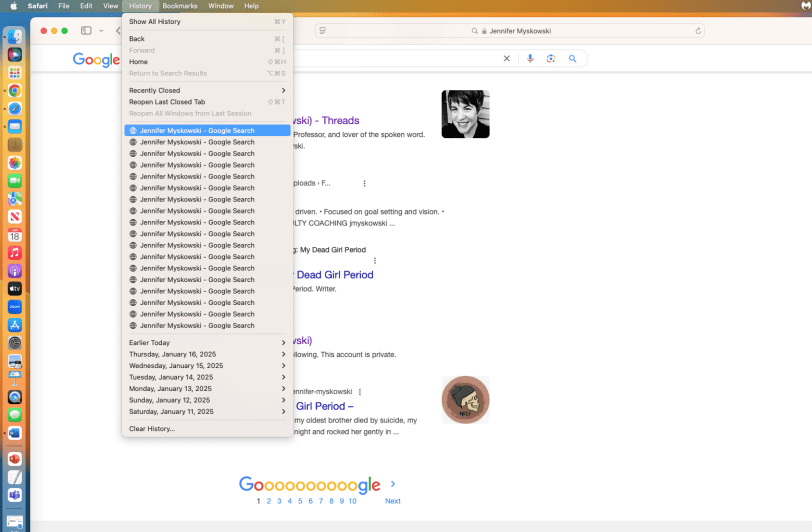
When Stalker’s behavior eventually shifted from shadowing to excoriating me and my family online, I decided that it was time to act. I sought help from a variety of groups and people, including from online providers regarding how to deal with a digital stalker, and some of them even blocked Stalker and limited their ability to act for a short time in the online environment. Ultimately, consultations resulted in me and my family accepting the advice that made the most sense, despite how unpalatable it was. I documented every instance of proof I had that Stalker was indeed stalking me and then I notified people who were mutual acquaintances of mine and Stalker’s that I was being stalked online and that I was no longer able to be friends in the digital world with them. My husband and kids did the same. We never revealed Stalker’s name to anyone. I still don’t know if that was the right decision. We intervened in several other ways to preserve our reputations and identities, but for our protection, these remain private because I am not naive to believe Stalker has absented themselves from our digital lives, even though we have absented Stalker from our real ones.
Do NOT underestimate the cost we have endured with this action alone. It has meant that we have cut off people from our lives for some sanity and protection, and because so much of how we communicate and maintain connections in the 21st century is online, we have shut the door on opportunities and relationships unless and until we know with whom we are really interacting.
Stalker was enraged when they learned that we had determined our only course of action was to cut off mutual acquaintances and family in the digital world, perhaps because Stalker worried others could guess that they were the guilty culprit. This no longer mattered to me, though, and I took the advice seriously to avoid direct confrontation with them because I have never fared well in these interactions.
I regret to admit I also sought redress, but it did not last long. If Stalker could shadow me, why couldn’t I shadow Stalker? I was very quickly able to find some information online about Stalker that I could use as defense against them, but in the process, I also realized the very dangerous and miserable reality that the watcher is not living. My Stalker resides in the unreality of my digital world and has spent no doubt an obscene and tragic amount of time avoiding the real one. Why would I want to join Stalker there?
And for me, this is the part of this story that is most dangerous and also most heartbreaking. Indeed, if Stalker really wanted to know me and my family, the digital realm is not where we reside. While our digital identities very nearly reflect the mundane quality of most of our days, I never revealed to Facebook or Twitter my most tragic mistake, the one that keeps me up at night still. And only my closest friends know that two years ago I lost nearly 75% of my hair and the reason why. Stalker does not realize that my husband has been writing a collection of poetry or that my kids had their own set of obstacles and successes. Stalker does not know who we mourn, what enrages us, the foods we love, or the dogs we own. And while Stalker seems to have viewed every single interview and podcast my husband recorded and posted online, they will never understand how hurt he was when they tried to misrepresent one of these podcasts to a relative. In fact, with limited access to me, Stalker has moved on to hunting my husband, and we worry that our children will be next.
I worry too about six-year-old me and the distance I have traveled to now looking over my real and digital shoulder wondering if Stalker is lurking. I do not understand the preoccupation with my little life and the reasons why Stalker thinks I should defend my choices when my life has never affected theirs and I have never wanted what they have—except for a second chance to make a wreath for my teacher and the freedom to live a private life that I do not have to defend simply because it is mine.
One of my friends who has watched me struggle with Stalker in real life and online encouraged me to exorcise them in a healing ceremony with my husband and children, some physical act that signals we are done with Stalker. And so the four of us have carried the heavy weight of Stalker to the top of the Grand Canyon, to dormant volcanoes in Hawaii, and to the edges of Iceland’s cold waterfalls formed from melting glaciers to see if we might be able to release the pain and fear we have experienced because of them. But even I knew before we arrived at these places, including the dead and echoless lava tubes on an island at the end of the world, that I could not leave Stalker in the places that brought wonder and awe to my family on the precious vacations we plan together every year. So while my family has attempted to leave Stalker behind along the way, I always brought Stalker home.
But I am finally done with carrying this burden, and I have determined that there is only one place for me to leave Stalker and save myself. For once and always I have decided to abandon Stalker here, lurking alone in the digital wasteland, where Stalker can read over and over and over again how I brought them to an end.

If you have been a victim or suspect you have been victimized by online stalking, there are resources that can help you end the trauma and make your stalker accountable.
Stalking Prevention, Awareness, & Resource Center (SPARC)

 My Dead Girl Period
Leave a reply to Christine Garand Scherer Cancel reply