
In the summer of 1989, approximately six months after Pam Am Flight 103 exploded from a terrorist’s bomb over Lockerbie, Scotland, with 270 people perishing—including 35 college students who were traveling home from studying abroad—my frightened parents hugged and kissed me goodbye in the parking lot of Juniata College, knowing that within a week I would be on another transatlantic flight from JFK to London. My plane would transport 15 incoming freshman, first to England, and from there we would be ferried and bussed to Belgium, the Netherlands, and France as part of a new scholarship program initiated to recruit students and promote the college’s political science and art history programs.
For three decades and counting afterward, my sister would complain to my parents that they let me go on this trip, but that when she wanted to travel to Cancun on a Spring Break adventure with her friends, they refused and claimed that there was not enough money. The accusation is that I “got something” my sister did not. That I was “The Favorite.”
The truth, however, is that I ended up on that plane and that trip because I was smart, but not smart enough.
The truth also is that the trip was free. The plan was for the students, two teachers, and one college admissions representative to travel throughout Western Europe to important cultural, political, and historical sites while earning six college credits in political science and art history. The college also hoped that upon our return, we would become ambassadors for Juniata with other potential students and leaders on campus. Perhaps because the college rather quickly realized that it was a costly sojourn, there was only one more group of students the next year who were recruited for the very same experience.
My sister’s jealousy, however, is well placed because my journey to Europe as a naive 18-year-old on my first passenger jet and solo trip to a foreign country changed my life. But what my sister cannot comprehend to this day is that it was the college experience that I returned home to in sleepy little Huntingdon, Pennsylvania, that is more precious than the day I spent in Notre Dame or the hours I sat in front of paintings in the Louvre.
I was not supposed to attend Juniata College (pronounced JOO-NEE-AT-UH). That was not my plan. It was the fourth college I applied to and my last choice. I only included it on my list because my high school advisor said I should pick at least one college in Pennsylvania where I lived, and since Juniata offered Russian, which I had been studying since middle school and because it was my intention to become an FBI agent, it seemed like a reasonable school to apply to “just in case.”
My top choice was the College of William and Mary. While I was accepted there, the aid I could access was very small. I was the fourth of five kids in my family, and so while my parents sacrificed a great deal to see all of us through college, they and I would incur tremendous debt at William and Mary. I knew it was not a possibility. When I found out that one of my high school friends was accepted to Wellesley College, also to earn a degree in Russian, I knew immediately that she would have access to people and opportunities I would never see. And for some reason, I felt sad and scared about what that meant for me.
My academic performance in high school was excellent. I was an obvious nerd who loved to read and write, I participated in many activities, I had won awards in English and history, I was involved in my Catholic church and the National Honor Society. My SAT scores were good, but they were not exceptional, and the truth is, I was competing with many exceptional people at William and Mary who had stronger academic records, higher SATs, and more money.
When a representative from Juniata College, where I was accepted and offered sufficient aid and scholarships, invited me to the school to tour it, meet with Russian Professor Dr. James Roney, and complete some placement exams, I went and realized almost immediately that the place seemed like a good fit. “You’ll be a big fish in a little pond,” my advisor told me. About a month after that visit, Juniata contacted me to offer me the scholarship to Europe, and I accepted without hesitation. I was going to Europe. It wasn’t Wellesley, but it made me special, and it was more than enough of a tradeoff for attending a school that no one knew how to pronounce.
I never became an FBI agent. I didn’t even come close.
What I did become was centered.
Here’s what happened:
The men and women whom I count as my most important teachers were present or arrived soon after I showed up at Juniata, and together with some of the most important works of literature and art, they revealed to me where the edges of my being were, and that I needed to test those edges to expand them and to figure out what I wanted to be once I figured out who I was.
They made me march with them down empty roads, through death camps, across the plains, inside the gulags, into the circles of hell and confessionals, to the woods and through rooms of my own. In Russian and English I read War and Peace, The Idiot, and The Brothers Karamazov, and dedicated myself wholly to the experience so that I went blind temporarily while doing so, ending up in an emergency room, and later there again sick with Epstein-Barr. But I was not allowed to leave college because, Dr. Roney mused, “You might not come back.” I went to see a preacher deliver a sermon on the Book of Revelations before confronting a semester of apocalyptic literature with Dr. Peter Goldstein, who also gently chastised me for relying on block quotes to fill the 20-page essay he assigned instead of integrating my sources and analyzing them. When I was in their classes and in their offices, I saw men and women negotiating ideas with words. These same men and women who were worried about their families, wondering about religion, careers, illnesses, competition, poems, research, bureaucracy, and on and on, were not shy about placing me in uncomfortable circumstances to show me that the discomfort could be borne if only I was willing to pause, consider, reason, reflect, and wonder.
In Europe, before my three-and-a-half years at Juniata ended, as I foolishly graduated early because the work was done and the scholarship money was depleted, I walked through The Anne Frank House in Amsterdam with Dr. Karen Rosell, and I remember whispering to her that I felt like I was watching myself from some other world perched in the past, but at Juniata I saw clearly out of my own eyes to a future and felt my soul, weighty and real.
On more than one occasion, sitting in a chair outside of Professor Ralph Church’s office door, I waited impatiently for him to finish staring at a tree framed in his window before he was ready to talk to me and waived me gently and slowly into a conversation about a paper that was good—but not good enough—and his recommendation that as a competent student writer, maybe I should consider being one for real.
Later, outside of that same office, I eavesdropped at the closed door to an argument between Dr. Roney and Professor Church about whether I should take Southern Gothic Literature or Women’s Literature because I needed the latter, Roney reasoned: “She has never taken a class where women writers are at the center.” Roney, unconvinced that Southern Gothic Literature was necessary, would later amend my Program of Emphasis, the specialized and self-directed course of study Juniata is known for, to eliminate a journalism course and replace it with Women’s Literature with Dr. Judith Katz, where I met Jamaica Kincaid, Toni Morrison, Alice Walker, Jeanette Winterson, Mary Wollstonecraft, bell hooks, Virginia Woolf…and myself.
When they let me go, I had read thousands of lives gone awry and could not predict that those lives would help me find a way through my own. I had not turned away from religion, an unfair accusation some make about people who have earned a college education, but toward it, and I understood the power of being an agent in one’s own destiny. Only a year later, I abandoned a 4.0 and a creative writing teaching assistantship at Southern Illinois University because I knew it was just not the right place, and I found another home at Iowa State University, where new professors helped me readjust a soul slightly out of alignment. I earned a Master’s Degree in Literature from ISU and then struggled to find a job and worked my way through employment in Iowa, New York, and Pennsylvania. Along the way, I would persuade a Catholic priest that I wanted my birth name to remain mine after marriage. That I could be a practicing, married Catholic and a Myskowski at the same time. He acquiesced and introduced Jennifer and Scott (Scott Beatty, Juniata College Class of 1991) at our wedding, and in this manner we remain in a happy, truly special and loving marriage that we had hands in shaping because we knew we could. I thank Juniata for that, too.
Eventually, I planted myself firmly at a community college in another small town in Pennsylvania, experienced and fought pregnancy discrimination, had two quirky and wonderful children, and am thrilled to this day to be an English professor with 23 years (so far) in the classroom. Though, I am also in disbelief that people are banning many of the very same books that brought me to neverending conversations in search of the truth, first with my professors, and now with the amazing students I am lucky enough to see in dwindling numbers of literature classes at my college. Still, every year I witness over and over again a centering that occurs for some, when they realize they are in the right place, reading incredible stories, and the right people are cheering and challenging them on to feel the weight of their souls.
Not all colleges are right for students and not every student is right for college. Not everyone can go to Wellesley or William and Mary, and sometimes the ideal places are hidden in the middle of nowhere and they have unpronounceable names. But more often than not, the place is not what counts, it is the people who are there and the subject of study, and I had the best people taking care of me and guiding me to a life that I would not trade with anyone. Humanities and literature classes, specifically, are no longer fashionable because the jobs attached to them don’t pay a lot, and AI is winning over the lazy writers who know that thinking and forming ideas is hard work. Trips to Cancun seem common now for college students on Spring Break, but I hope there are a few students left who will take a chance on building a more fulfilling life around books and writers instead of partying on a Mexican beach. I am smart, but I know I am not smart enough to offer a fix to those who malign education and ban books when many of them need what those offer.
Today, though, I still sometimes feel like that girl waiting outside Professor Church’s office for him to finish staring at his tree, only I am no longer impatient. In fact, I’d be fine if time slowed down. I know I am lucky, and I know that those men and women and the literature and art they brought me to allowed me to see and build a life that continually leaves me in awe. At the start of my fifth decade, thirty years since I graduated from Juniata College, now I can see the signs.
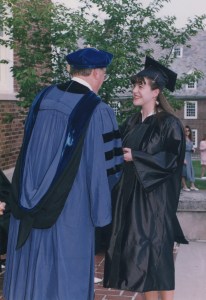
magna cum laude


 My Dead Girl Period
Leave a reply to Jacqline Wolf Tice Cancel reply